
The Equipment That Protects Your Bike During Transport: Wheel Chocks, Soft Straps, and Professional Techniques
A motorcycle has none of the built-in protection a car offers on a tow truck. There is no cage, no four-point stance, and no bumper to hook. For riders across Kansas City, Shawnee, and Olathe, knowing how a bike should be secured is the difference between arriving in perfect shape and showing up with scratched paint or a bent lever. The gear and the method both matter.
Why Motorcycles Demand Different Handling
A bike balances on two contact patches and tips the moment that balance is lost. It cannot be dragged, winched by the frame, or chained down like a sedan. Every point where a strap touches the machine is a point where paint, plastic, or a control can be marred. Transporting one safely means keeping it upright, distributing tension, and treating the finish as if it were glass, which is why proper bike transport looks nothing like loading a car.
The Wheel Chock: A Bike’s Anchor Point
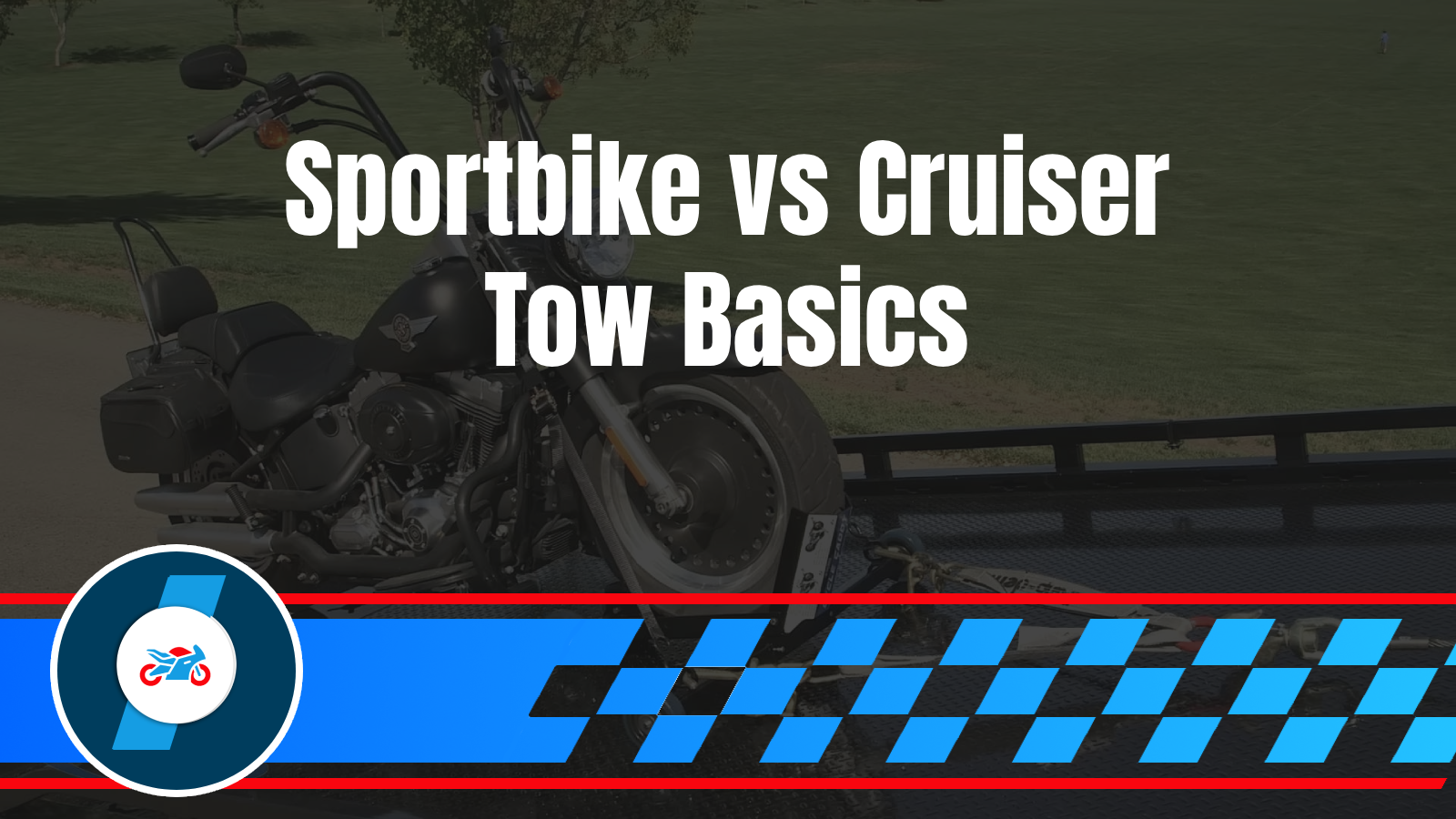
The foundation of a safe load is a front wheel chock. This cradle grips the front tire and holds the bike vertical while the straps are set, taking the guesswork out of balancing a heavy machine on a moving deck. A quality chock locks the wheel so the motorcycle cannot roll forward or fall to one side during loading. Without one, a rider is left holding the bike and cinching straps at the same time, which is exactly how bikes get dropped.
Soft Straps and Why They Matter
Ratchet straps are strong, but their hooks and coarse webbing can chip paint and scratch triple clamps or handlebars. Soft straps solve that. These are loops of smooth, wide webbing that wrap around a solid part of the bike, giving the ratchet strap something soft to connect to instead of bare metal or a painted surface.
- Soft straps wrap solid points without touching paint or plastic
- Ratchet straps connect to the soft loops, never directly to the bike
- Compressing the fork a controlled amount keeps tension steady over bumps
- Straps set at opposing angles stop side-to-side sway
- A tie-down at the rear balances the front and settles the suspension
Professional Loading Techniques
Securing a motorcycle is a sequence, not a scramble. The bike is rolled into the chock and held upright, then the front is anchored with soft straps run to opposite sides so the fork compresses evenly. A modest amount of compression preloads the suspension so the bike does not bounce loose on rough pavement, and rear straps balance the setup.
Throughout, the operator checks that nothing bears on a brake line, cable, or fairing. On a flatbed the low load angle makes the whole process gentler than a steeply ramped trailer.
What Riders Can Do Before Pickup
A few small steps make loading faster and safer. Put the bike in neutral, make sure the fuel petcock is off if your machine has one, and point out any aftermarket parts or fragile bodywork to the operator. Let the driver know if the steering lock is engaged or the battery is dead, since a bike that cannot roll freely changes how it is handled. Clear communication up front means the crew arrives with the right approach for your specific motorcycle.
Protecting Your Bike Through Kansas Roads and Weather
Kansas City pavement is not kind. Frost heaves, expansion joints on I-435, and summer-softened asphalt all shake a load. A properly chocked and strapped bike absorbs that without shifting. Weather adds its own concern, since a sudden storm or road grime can reach an exposed machine, so shielding the bike on longer hauls is part of doing the job right. The goal is simple: deliver the motorcycle exactly as it left.
Need your motorcycle moved with the care it deserves anywhere in the Kansas City metro? Call Kansas Towing at (816) 608-4886. Learn about our motorcycle towing and our flatbed towing service.


